
Categories
FAQ
-
The WELL Building Standard and Lighting Explained
What is WELL V2 - WELL Building Standard Version 2?
There are 4 primary lighting features that are defined in the WELL Building Standard V2 that lighting designers, and engineers can use to meet the necessary criteria. The WELL Light concept promotes exposure to light and aims to create optimal lighting environments for biological, visual and mental health.
There are eight (8) features (L01-L09) comprised in this Light concept of the WELL Building Standard that define and prescribe specific technical requirements. These technical requirements will require confirmation from lighting manufactures so that lighting designers and engineers can properly determine if their design will meet the Standards needs.
These 4 primary lighting features relevant for lighting designers, engineers and manufacturers. Each of these has a separate FAQ available:
- Melanopic Ratio (L02 Circadian Lighting Design)
- Glare (L04 Electric Light Glare Control)
- Color Rendering (L08 Electric Light Quality - Part 1 Enhance Color Rendering Quality)
- Flicker (L08 Electric Light Quality - Part 2 Manage Flicker)
SAL Commercial has a WELL AP ( Accredited Professional) on staff. Simon Richardson, WELL AP, is available to assist with WELL Building Standard questions. -
The WELL Building Standard V2 ( L04 Electric Lighting Glare Control) Guidelines
What are the WELL Building Standard V2 Electric Lighting Glare Control Guidelines? (L04 Electric Lighting Glare Control)
L04 Electric Lighting Glare Control is focused on managing glare control using combinations of strategies as careful space planning and lighting design can minimise the amount of glare experienced by occupants.
- There are a maximum of 2 Points achievable.
- This needs to be verified by a Technical Document.
The Standard describes L03 as: “This WELL feature requires projects to manage glare by using strategies, such as calculation of glare and choosing the appropriate light fixtures for the space.”
The Requirements set our are:
Option 1:
Each luminaire meets one of the following requirements for regularly occupied spaces at light output representative of regular use conditions. Wall wash fixtures and concealed fixtures, installed as specified by manufacturer’s data, as well as decorative fixtures may be excluded from meeting these requirements:
a) 100% of light is emitted above the horizontal plane.
b) Classified with Unified Glare Rating (UGR) of 16 or lower.
c) Luminance that does not exceed 6,000 cd/m2 at any angle between 45 and 90 degrees from nadir.
This can be represented per luminaire in a table by the manufacturer as per the following example.
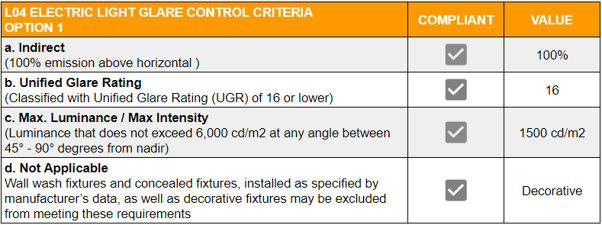
Remember the luminaire has to meet ONE of those requirements and documentary proof the results are required.
In additional Option 2; Space Consideration states that:
The following requirement is met in all regularly occupied spaces:
a) Unified Glare Rating (UGR) of 16 or lower.”
-
The WELL Building Standard V2 L08 Electric Light Quality Guidelines
What are The WELL Building Standard V2 L08 Electric Light Quality Guidelines?
L08 Electric Light Quality is focused on characteristics of lights such as colour rendering, colour quality and flickering.
This has a lot more considerations to it however the first part at least - Enhance color rendering quality - is straightforward.
- There are a maximum of 3 Points achievable.
- This needs to be verified by a Technical Document.
- There are 2 Parts - Part 1 provides 1 point; Part 2 provides 2 points.
- Both parts are NOT required for L08 to be met as points are divided into separate parts
The Standard describes L08 as: “This WELL feature requires projects to take into account characteristics of electric light used in the space, such as color rendering and flicker.”
For Part 1 - Enhance Color Rendering Quality - There are different requirements for Circulation Areas and All areas BUT Circulation Areas.
In short:
- Circulation Areas >= CRI80; IES Rf ≥ 75, IES Rg ≥ 95, -7% ≤ IES Rcs,h1 ≤ 15%.
- All but Circulation Areas; CRI ≥90.; CRI ≥ 80 with R9 ≥ 50.
For all A Grade commercial office fitouts in Australia this would be common-place today. The WELL Building Standard formalises this requirement specifically ensuring that this basic requirement is met, if for some reason a vale engineering process was attempting to offer an under performing alternate light source.
The specific requirements set out for all but circulation spaces are:All luminaires (except decorative fixtures, emergency lights and other special-purpose lighting) meet at least one of the following color rendering requirements. If tunable white lighting is used, the requirements are met at 1,000K intervals from the lower end (with a minimum of 2,700K) to the higher end (with a maximum of 5,000k):
- CRI ≥90.
- CRI ≥ 80 with R9 ≥ 50.
- IES Rf ≥ 78, IES Rg ≥ 100, -1% ≤ IES Rcs,h1 ≤ 15%.
This can be represented per luminaire, in a table by the manufacturer as per the following example.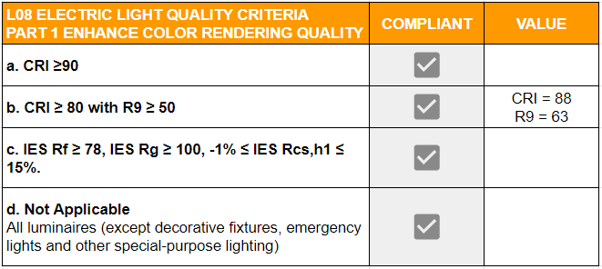
Remember the luminaire has to meet at least ONE of those requirements and documentary proof the results are required.
Part 2 - Manage Flicker - with an additional 2 Points available is very prescriptive in its requirements.
Find Part 1 of L08 Electric Light Quality here
The specific requirements set out are:
All luminaires, in combination with the appropriate controls (except decorative lights, emergency lights and other special-purpose lighting), used in regularly occupied spaces meet at least one of the following flicker requirements:Option b) - is the one we are most likely to depend upon in Australia
b. Recommended practices 1, 2 or 3 as defined by IEEE standard 1789-2015 LED.9
As a guideline a minimum frequency of 90 Hz at 10% light output intervals from 10% to 100% light output
Essentially this constitutes a statement of compliance for LED luminaires with the IEEE Standard 1789-2015 with supporting values for full light output.
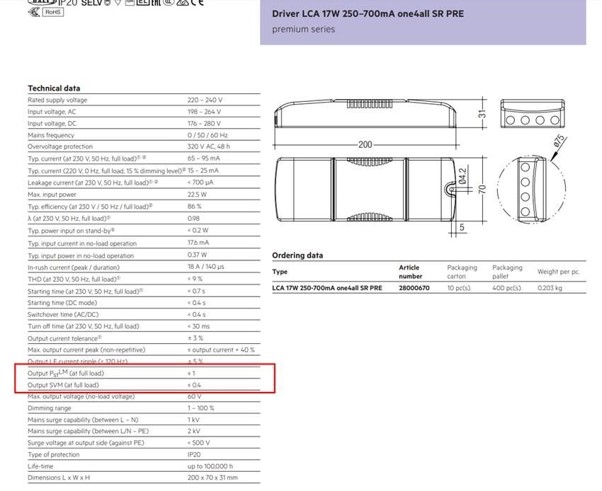
Many drivers from reputable manufacturers also provide data on the driver which provide clarity with respects to their compliance to Part C:
c. Pst LM ≤ 1.0 and SVM ≤ 1.6 for indoor applications per NEMA 77-2017.10,11
Below is an image of a Tridonic branded driver with the compliant area marked:
-
The WELL Building Standard V2 Melanopic Ratio ( L03 Circadian Lighting Design) Guidelines
What are the WELL Building Standard V2 guidelines for Melanopic Ratio? ( L03 Circadian Lighting Design) L03 Circadian Lighting Design is focused on maintaining circadian health and ensuring an alignment with the circadian rhythm of individuals with the day-night cycle. This part L02 is about providing users with appropriate light exposure.
- There are a maximum of 3 Points achievable.
- This needs to be verified by a performance test.
The Standard describes L03 as: “This WELL feature requires projects to provide users with appropriate exposure to light for maintaining circadian health and aligning the circadian rhythm with the day-night cycle..”
The Requirements set our are:
For workstations used during the daytime, electric lighting is used to achieve the following thresholds:
The following light levels are achieved for at least four hours (beginning by noon at the latest) at a height of 45cm above the work-plane for all workstations in regularly occupied spaces:
This is a summary of those requirements from the IALD:EML Stands for Equivalent Melanopic Lux and is defined by the photopic lux multiplied by a melanopic ratio, EML - LxR
To calculate the equivalent melanopic lux (EML), multiply the visual lux (L) designed for or measured in a building by this ratio (R): EML = L × R. For example, if incandescent lights provide 200 lux in a space, they will also produce 108 equivalent melanopic lux. If daylight is modeled to provide the same visual brightness (200 lux), it will also provide 220 equivalent melanopic lux.
Source: https://standard.wellcertified.com/tables
See also: Table L2: Melanopic and Visual Response which provides more descriptive information: To calculate the melanopic ratio of light, start by obtaining the light output of the lamp at each 5 nm increment, either from manufacturer or by using a spectrometer. Then, multiply the output by the melanopic and visual curves given below to get the melanopic and visual responses. Finally, divide the total melanopic response by the total visual response and multiply the quotient by 1.218Source: https://standard.wellcertified.com/tables
For more information read the following Measuring and using Lighting in the Melanopsin Age by Luca, RJ et al.
Manufacturers must use the IWBI Melanopic Ratio tool or equivalent tool for each unique light spectrum and provide a value of melanopic ratio.
