
Categories
FAQ
-
Can I use a dimmer to control a sensor?
Can I use a dimmer to control a sensor?
No - Dimmers are designed with a minimum load requirement, hence when a sensor turns off the light, the load detected by the dimmer will be insufficient to maintain the control.
-
Cutting LED Strip kits
My LED strip KIT, which I have just cut to (a shorter) length, is momentarily "blinking" or "flickering" when I turn the LED OFF.
This event is not a safety issue and typically occurs when the LED Strip load falls below the threshold of the driver design limit, which will result in a minor capacitive discharge in the form of the LED strip momentarily "blinking" or "flickering" when the power is turned off. When cutting LED strips KITS, it is always important to calculate the remaining LED load to reconfirm its compatibility with the existing driver, as driver changes may be required with moderate reduction in loads,
-
Dimming products what are the issues?
Dimming products what are the issues?
As there is no global performance standard for dimming devices (other than safety and EMC) it is important to consulate with your supplier the compatibility of the devices you propose to install. Minimum loads and dimming performance limits are critical ratings that must be considered when using such devices.
-
Does SAL Commercial offer extended warranties?
Does SAL Commercial offer extended warranties?
Yes and these warranty extensions are detailed on the relevant product installation sheet or web page.
-
I have a warranty claim who do I contact?
I have a warranty claim who do I contact?
This first point of contact should be the place of original purchase, after which they will be responsible to coordinate the warranty communication with the SAL Commercial Customer service team.
-
Is aiming orientation important for exterior products?
Is aiming orientation important for exterior products?
Absolutely, careful attention is required when installing exterior products to ensure the designated aiming orientation is correct and allows for the natural cleaning of debris/dust from the glass visor surface, in particular when aimed in an upward direction. Products aimed in an upward direction can result in a build-up of dirt on the glass visor, which in turn can thermally stress the product if it is not routinely cleaned. Any aiming restrictions can be found with the installation instructions located in the product carton and or on the relevant product web page.
-
Is it mandatory for in-scope products and (or carton packing where the product size is too small) to be marked with the RCM logo?
Is it mandatory for in-scope products and (or carton packing where the product size is too small) to be marked with the RCM logo?
Yes.
-
Is lumen maintenance and rated life the same?
Is lumen maintenance and rated life the same?
Simple answer is NO. Although documented as “hours” Lumen maintenance with LED products is calculated through the combination of LM79, LM80 and TM21 reporting methodologies and reflects as a guide “useful” time duration of the light source. Rated life on the other-hand (when stated) denotes the rated average LED failures over a given time, shown typically shown as rated survival hours.
-
Is SAL Commercial a member of Lighting Council Australia?
Is SAL Commercial a member of Lighting Council Australia?
Yes
-
Is SAL Commercial Australian owned and operated?
Is SAL Commercial Australian owned and operated?
Yes
-
Is SAL Commercial registered as a responsible supplier of ERAC?
Is SAL Commercial registered as a responsible supplier of ERAC?
Yes
-
LED what does it stand for?
LED what does it stand for?
Light Emitting Diode, with the first (red) visible spectrum LED being invented in 1962 by Nick Holonyak
-
MEPS what does it stand for?
MEPS what does it stand for?
(MEPS) Minimum Energy and Performance Standards is a Commonwealth Government Greenhouse and Minimum Standards Act, which focusses on the reduction of inefficient electrical sources, one of which is traditional Lighting equipment.
Regulated products for Lighting are: Fluorescent lamp ballasts, linear fluorescent lamps, transformers and converters for halogen lamps, compact fluorescent lamps and incandescent lamps. For more information on MEPS www.energyrating.gov.au/products/lighting -
Product maintenance is it important?
Product maintenance is it important?
The simple answer is Yes. Electrical products are just like your vehicle when it comes to maintenance requirements. They both collect dust and require cleaning and they both have components that require routine inspection and adjustments. Please refer to any specific maintenance instruction on the SAL Commercial installation sheet or web site.
-
Q1 - What is anti-microbial used for in medical lighting in Australia
What does anti-microbial mean and why this is important for medical lighting in Australia?
Silver is a well-documented antimicrobial, that has been shown to kill bacteria, fungi and certain viruses. It is the positively charged silver ions (Ag+) that possess the antimicrobial effect. Silver ions target microorganisms through several different modes of action.
In healthcare applications where medical lighting, examination lighting, minor procedure lighting, minor surgical lighting and surgical lighting are critical in the transmission of pathogens by human hands. Being a high touch surface, medical lighting products require an extra-ordinary level of protection to try mitigate accidental contamination.
Brandon Medical Coolview, Astralite, Astramax and Quasar products incorporate the anti-microbial substance into the light head during manufacturing. This inhibits the growth of and proliferation of microbes and bacteria, whilst the silver ions destabilise the cell membrane.
This prevents the bacteria from multiplying. Tests have shown that 99% of bacteria and germs are destroyed using the Sanitized® and Biomaster® active substance.
-
RCM mark what does it mean?
RCM mark what does it mean?
This mark, which is mandatory for in-scope lighting and electrical products in Australia, which confirms the product complies with applicable safety and EMC standards.
-
SDOC what does it mean?
SDOC what does it mean?
Suppliers Declaration of Conformity. A SDOC is typically a document that a supplier generates to confirm mandatory safety and performance testing for a particular product has been completed, in lieu of distributing expansive original test reports, which generally are best read by qualified persons. At a minimum a SDOC for lighting equipment should present the relevant Safety and EMC test reports and test report numbers, together with the relevant model numbers of the equipment being offered. The SDOC should be supplied and endorsed by the authorised supplier of the equipment.
-
Should I need to consider humidity and operating conditions?
Should I need to consider humidity and operating conditions?
Humidity can play havoc with electronic circuits (more commonly known in light as LED’s) This data can be found on SAL installation sheets and should be considered before installation of equipment.
-
The WELL Building Standard and Lighting Explained
What is WELL V2 - WELL Building Standard Version 2?
There are 4 primary lighting features that are defined in the WELL Building Standard V2 that lighting designers, and engineers can use to meet the necessary criteria. The WELL Light concept promotes exposure to light and aims to create optimal lighting environments for biological, visual and mental health.
There are eight (8) features (L01-L09) comprised in this Light concept of the WELL Building Standard that define and prescribe specific technical requirements. These technical requirements will require confirmation from lighting manufactures so that lighting designers and engineers can properly determine if their design will meet the Standards needs.
These 4 primary lighting features relevant for lighting designers, engineers and manufacturers. Each of these has a separate FAQ available:
- Melanopic Ratio (L02 Circadian Lighting Design)
- Glare (L04 Electric Light Glare Control)
- Color Rendering (L08 Electric Light Quality - Part 1 Enhance Color Rendering Quality)
- Flicker (L08 Electric Light Quality - Part 2 Manage Flicker)
SAL Commercial has a WELL AP ( Accredited Professional) on staff. Simon Richardson, WELL AP, is available to assist with WELL Building Standard questions. -
The WELL Building Standard V2 ( L04 Electric Lighting Glare Control) Guidelines
What are the WELL Building Standard V2 Electric Lighting Glare Control Guidelines? (L04 Electric Lighting Glare Control)
L04 Electric Lighting Glare Control is focused on managing glare control using combinations of strategies as careful space planning and lighting design can minimise the amount of glare experienced by occupants.
- There are a maximum of 2 Points achievable.
- This needs to be verified by a Technical Document.
The Standard describes L03 as: “This WELL feature requires projects to manage glare by using strategies, such as calculation of glare and choosing the appropriate light fixtures for the space.”
The Requirements set our are:
Option 1:
Each luminaire meets one of the following requirements for regularly occupied spaces at light output representative of regular use conditions. Wall wash fixtures and concealed fixtures, installed as specified by manufacturer’s data, as well as decorative fixtures may be excluded from meeting these requirements:
a) 100% of light is emitted above the horizontal plane.
b) Classified with Unified Glare Rating (UGR) of 16 or lower.
c) Luminance that does not exceed 6,000 cd/m2 at any angle between 45 and 90 degrees from nadir.
This can be represented per luminaire in a table by the manufacturer as per the following example.
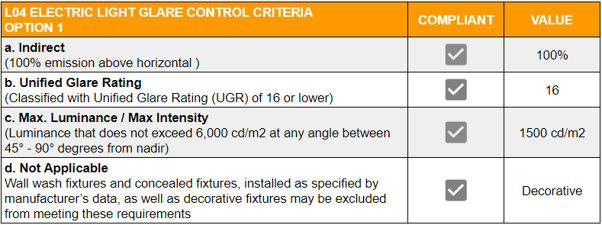
Remember the luminaire has to meet ONE of those requirements and documentary proof the results are required.
In additional Option 2; Space Consideration states that:
The following requirement is met in all regularly occupied spaces:
a) Unified Glare Rating (UGR) of 16 or lower.”
-
The WELL Building Standard V2 L08 Electric Light Quality Guidelines
What are The WELL Building Standard V2 L08 Electric Light Quality Guidelines?
L08 Electric Light Quality is focused on characteristics of lights such as colour rendering, colour quality and flickering.
This has a lot more considerations to it however the first part at least - Enhance color rendering quality - is straightforward.
- There are a maximum of 3 Points achievable.
- This needs to be verified by a Technical Document.
- There are 2 Parts - Part 1 provides 1 point; Part 2 provides 2 points.
- Both parts are NOT required for L08 to be met as points are divided into separate parts
The Standard describes L08 as: “This WELL feature requires projects to take into account characteristics of electric light used in the space, such as color rendering and flicker.”
For Part 1 - Enhance Color Rendering Quality - There are different requirements for Circulation Areas and All areas BUT Circulation Areas.
In short:
- Circulation Areas >= CRI80; IES Rf ≥ 75, IES Rg ≥ 95, -7% ≤ IES Rcs,h1 ≤ 15%.
- All but Circulation Areas; CRI ≥90.; CRI ≥ 80 with R9 ≥ 50.
For all A Grade commercial office fitouts in Australia this would be common-place today. The WELL Building Standard formalises this requirement specifically ensuring that this basic requirement is met, if for some reason a vale engineering process was attempting to offer an under performing alternate light source.
The specific requirements set out for all but circulation spaces are:All luminaires (except decorative fixtures, emergency lights and other special-purpose lighting) meet at least one of the following color rendering requirements. If tunable white lighting is used, the requirements are met at 1,000K intervals from the lower end (with a minimum of 2,700K) to the higher end (with a maximum of 5,000k):
- CRI ≥90.
- CRI ≥ 80 with R9 ≥ 50.
- IES Rf ≥ 78, IES Rg ≥ 100, -1% ≤ IES Rcs,h1 ≤ 15%.
This can be represented per luminaire, in a table by the manufacturer as per the following example.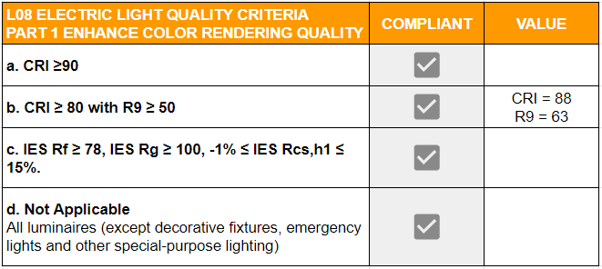
Remember the luminaire has to meet at least ONE of those requirements and documentary proof the results are required.
Part 2 - Manage Flicker - with an additional 2 Points available is very prescriptive in its requirements.
Find Part 1 of L08 Electric Light Quality here
The specific requirements set out are:
All luminaires, in combination with the appropriate controls (except decorative lights, emergency lights and other special-purpose lighting), used in regularly occupied spaces meet at least one of the following flicker requirements:Option b) - is the one we are most likely to depend upon in Australia
b. Recommended practices 1, 2 or 3 as defined by IEEE standard 1789-2015 LED.9
As a guideline a minimum frequency of 90 Hz at 10% light output intervals from 10% to 100% light output
Essentially this constitutes a statement of compliance for LED luminaires with the IEEE Standard 1789-2015 with supporting values for full light output.
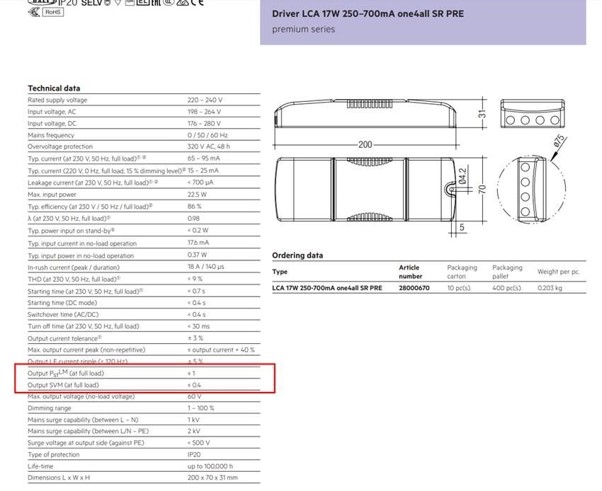
Many drivers from reputable manufacturers also provide data on the driver which provide clarity with respects to their compliance to Part C:
c. Pst LM ≤ 1.0 and SVM ≤ 1.6 for indoor applications per NEMA 77-2017.10,11
Below is an image of a Tridonic branded driver with the compliant area marked:
-
The WELL Building Standard V2 Melanopic Ratio ( L03 Circadian Lighting Design) Guidelines
What are the WELL Building Standard V2 guidelines for Melanopic Ratio? ( L03 Circadian Lighting Design) L03 Circadian Lighting Design is focused on maintaining circadian health and ensuring an alignment with the circadian rhythm of individuals with the day-night cycle. This part L02 is about providing users with appropriate light exposure.
- There are a maximum of 3 Points achievable.
- This needs to be verified by a performance test.
The Standard describes L03 as: “This WELL feature requires projects to provide users with appropriate exposure to light for maintaining circadian health and aligning the circadian rhythm with the day-night cycle..”
The Requirements set our are:
For workstations used during the daytime, electric lighting is used to achieve the following thresholds:
The following light levels are achieved for at least four hours (beginning by noon at the latest) at a height of 45cm above the work-plane for all workstations in regularly occupied spaces:
This is a summary of those requirements from the IALD:EML Stands for Equivalent Melanopic Lux and is defined by the photopic lux multiplied by a melanopic ratio, EML - LxR
To calculate the equivalent melanopic lux (EML), multiply the visual lux (L) designed for or measured in a building by this ratio (R): EML = L × R. For example, if incandescent lights provide 200 lux in a space, they will also produce 108 equivalent melanopic lux. If daylight is modeled to provide the same visual brightness (200 lux), it will also provide 220 equivalent melanopic lux.
Source: https://standard.wellcertified.com/tables
See also: Table L2: Melanopic and Visual Response which provides more descriptive information: To calculate the melanopic ratio of light, start by obtaining the light output of the lamp at each 5 nm increment, either from manufacturer or by using a spectrometer. Then, multiply the output by the melanopic and visual curves given below to get the melanopic and visual responses. Finally, divide the total melanopic response by the total visual response and multiply the quotient by 1.218Source: https://standard.wellcertified.com/tables
For more information read the following Measuring and using Lighting in the Melanopsin Age by Luca, RJ et al.
Manufacturers must use the IWBI Melanopic Ratio tool or equivalent tool for each unique light spectrum and provide a value of melanopic ratio.
-
What does EMC stand for?
What does EMC stand for?
ElectroMagnetic Compatibility, which defines the use of different electronic devices (such as electrical appliances, medical equipment, LED’s and drivers etc) to operate without interference with other devices. This is a mandatory label (and testing) requirement for Australian Lighting equipment covered by AS/NZS CISPR 15. ACMA also recognise equivalent standards CISPR 15 and EN 55015.
-
What does IP stand for?
What does IP stand for?
IP (or Ingress and Protection) are an international standard reference which defines how well an electrical product seals itself against the intrusion of foreign bodies and moisture. The first digit I stands for intrusion of a solid object and the second digit P stands for the protection against moisture. In brief the higher the rating the more secure the product is against these elements.
As a guide IP20 is suitable for basic interior spaces eg: office areas, where IP55 and above would be suitable for exterior equipment such as floodlights.
For more information please refer to AS 60529.
-
What does L70 mean?
What does L70 mean?
For the digital LED world L70 is simply a measure of time that the light source will be reduced to 70% of its original (or initial) output. You will also see documented L90, which represents the measure of time where the product is reduced to 90% of its original (or initial output).
-
What is a LM79 report?
What is a LM79 report?
In street terms LM79 is a set of methodologies for laboratory testing of solid state luminaires, which will result in CCT, CRI, system power, luminous flux and distribution being reported.
-
What is a LM80 report?
What is a LM80 report?
In street terms LM80 is the test method for measuring lumen maintenance for a LED light source at the actual component level ie the LED.
-
What is a ta rating?
What is a ta rating?
(thermal ambient) is the recommended maximum environmental thermal limit for the safe continued operation of an electrical device. The ta rating can be found on the rating label and installation sheet, which is located on the relevant product web page. Typically, you will find ta ratings of 25 degree C for Interior products, where ta ratings of up to 50 degree C can be found for exterior products. Operating products beyond their designed ta limit is not recommended as it will stress the product components beyond their rated limits, resulting in reduced product performance or premature failure.
-
What is a TM21 report?
What is a TM21 report?
In street terms TM21 is a method to extrapolate the LM80 lumen maintenance data beyond the actual test duration and determine a projection of lumen maintenance as referenced by L70 or L90 (70% or 90% of the initial light source output).
-
What is an electrical CLASS I lighting product?
What is an electrical CLASS I lighting product?
This is a product that requires the installation of an earth to be compliant to AS/NZ 3000.
-
What is an electrical CLASS II lighting product?
What is an electrical CLASS II lighting product?
This is a product that does not require the installation of an earth to be compliant to AS/NZ 3000, as the product is a double insulation product.
-
What is an IK rating?
What is an IK rating?
An IK rating of a lighting product is covered by EN 62262 and is a measure of the impact resistance of a product. In brief the test process measures a products mechanical impact (impact energy joules) limits against a known mass and varied distances. As a guide the higher the IK rating (limit 10) the higher the products ability to withstand impact force.
High IK rated products (IK10) would be seen used in environments such as vandal prone installations, prisons as a guide.
-
What is Earth leakage current?
What is Earth leakage current?
Earth leakage current is an important electrical safety measurement and care should be considered when calculating earth leakage values. This data can be found on SAL Commercial installation sheets or for more details on the calculating method go to AS/NZ 60598.1.2013 table 10.3.
-
What is in-rush currents?
What is in-rush currents?
Like traditional HID circuits, LED despite the smaller electrical loads has its own limits when it comes to in-rush currents, which must be considered with all electrical circuits. This data can be found on SAL Commercial installation sheets.
-
What is the definition of an Emergency maintained fitting?
What is the definition of an Emergency maintained fitting?
This is an emergency light that remains ON at all time and remains ON during a supply failure for the designated time as per AS 2293. Maintained lights are typically (but not limited to) EXIT signs.
-
What is the definition of an Emergency non-maintained fitting?
What is the definition of an Emergency non-maintained fitting?
A non-maintained emergency light is one that is only used (on) for emergency lighting, hence in the event of a mains (supply) failure, the emergency light source will be activated.
-
What is the definition of Colour rendering index?
What is the definition of Colour rendering index?
(CRI) in street talk is a measure of how an illuminated object appears to the eye. As a guide the higher the CRI rating >85, the closer the illuminated object is when compared to standardized daylight. Typical CRI value available are: CRI70 for outdoor recreational sports, CRI80 for interior task areas, >CRI90 clinical observation tasks.
-
What is the definition of Colour temperature?
What is the definition of Colour temperature?
Si (k) denotes the colour temperature of a light source referenced against a black body radiator.
In street terms colour temperature is how warm or cool you see the light source.
eg : warm colours are typically 2700-3000k, which would generally be used in residential interior spaces.
cool colours are typically around 4000k, which would generally be used in office interior spaces.
cold colours (daylight) are typically 5000-6000k, which would generally be used in exterior spaces. -
What is the definition of Lumen output?
What is the definition of Lumen output?
Lumen (lumen lm) is the total light out of a light source measured as (initial lumens) representing the base or NEW lamp source lumens. (Rated lumens) is then measured after 100 hours usage for traditional lamp sources and LED sources are represented by L70 or L90 ratings.
-
What is the definition of Lux?
What is the definition of Lux?
Lux (lx) is the unit measure for how much luminous flux (lumens lm), which in street terms is LIGHT falling on a given surface. Lux can be accurately measured by a calibrated Light meter
-
What is the standard warranty for SAL Commercial products?
What is the standard warranty for SAL Commercial products?
In line with SAL Commercial standard terms and conditions of sale the standard warranty is twelve (12) months, unless stated otherwise on the product installation sheet and web page.
-
What is the title of the lighting safety standard for luminaires?
What is the title of the lighting safety standard for luminaires?
The mandatory luminaire general requirements and testing is covered by AS/NZS 60598.1:2013. This standard addresses essential electrical and operating performance tests for a lighting product, which is a must when selecting lighting products.
This standard is in addition to specific product standards such as AS/NZS 60598.2.2-2016 and AS2293.1.2005 Emergency Lighting as an example. -
What should be found on the product rating label?
What should be found on the product rating label?
As a minimum you should find all necessary electrical data to allow you to be informed about the electrical characteristics of the product to enable a safe and compliant installation such as RCM mark, company logo, voltage, line current, power, frequency, power-factor, country of origin, IP rating, batch number ta rating, cover ratings if applicable.
-
Where can I find SAL Commercial?
Where can I find SAL Commercial?
SAL Commercial has customer service centres in Brisbane, Sydney and Adelaide.
-
Where can I find the latest Australia standards / regulations for Lighting?
Where can I find the latest Australia standards / regulations for Lighting?
Electrical safety regulations – www.erac.gov.au
State based electrical regulators – see local State Electrical Authority for details.
Electro-magnetic compatibility regulations – http://www.acma.gov.au
ACMA LED specific advice regarding interference - www.acma.gov.au/theacma/led-globes-and-tv-reception
Energy efficiency regulations – http://www.energyrating.gov.au -
Where do I find the warranty term for SAL Commercial products?
Where do I find the warranty term for SAL Commercial products?
This information can be found on the product installation sheet located in the product carton or relevant product web page.
-
Where is SAL Commercial’s HO?
Where is SAL Commercial’s HO?
40 Biloela Street Villawood NSW 2163.
-
Who do I contact if I have special requirements that require an extended warranty?
Who do I contact if I have special requirements that require an extended warranty?
Simply follow the enquiry form on the WARRANTY page of this web site and a SAL Commercial team member will review the request and confirm the offer via a return email.
-
Who is ACMA?
Who is ACMA?
It is the Australian Communications and Media Authority (ACMA) who is responsible for administering the mandatory electromagnetic compatibility (EMC) regulatory arrangements for electrical and electronic devices supplied to the Australian market.
-
Why choose LED?
Why choose LED?
There many reason why to use an LED light source, however the two (2) headline reasons are;
(1) a significant reduction in electrical energy to achieve the same value of illumination and
(2) a significant reduction in operating costs.
